Multi Stop Route Planning for Recurring Field Service Businesses
Recurring field service businesses rely on efficient routes more than almost any other type of operation.
Unlike one-time service calls, recurring services happen on a predictable schedule. Pest control technicians return monthly. Lawn care crews visit properties every week. Pool service companies maintain the same pools throughout the season.
Because these visits repeat again and again, route quality compounds over time. A route that wastes 30 minutes every day might not seem dramatic at first, but over a month or a year that inefficiency becomes expensive.
That is why multi stop route planning plays such a central role. When stops are grouped logically and sequenced well, technicians spend less time driving and more time completing billable work. Businesses that design their recurring routes carefully often discover they can serve more customers without adding more vehicles or technicians.
How Recurring Service Routes Work
Most recurring field service companies organize their work around route days.
Instead of scheduling customers randomly throughout the week, businesses assign neighborhoods or service zones to specific days. For example:
- Monday — North neighborhoods
- Tuesday — West neighborhoods
- Wednesday — Central neighborhoods
- Thursday — South neighborhoods
Within each route day, technicians complete multiple stops in the same area.
This approach reduces unnecessary travel and allows technicians to move from property to property efficiently.
However, routes rarely start perfectly organized. As new customers are added over time, routes can slowly become fragmented. A technician may find themselves crossing between neighborhoods several times in a single day simply because new accounts were added wherever space was available.
Multi stop route planning helps recurring service businesses reorganize those routes so the workday flows more naturally.
Example Scenario: Pest Control Route
To understand how route planning affects recurring services, consider the following pest control route:
City: Phoenix, Arizona
Technician start location: North Phoenix
Service day: Monthly residential treatments
Stops scheduled: 15 homes
Properties scheduled for the day: Deer Valley, Deer Valley, Norterra, Deer Valley, Norterra, Norterra, Happy Valley, Deer Valley, Norterra, Happy Valley, Deer Valley, Norterra, Deer Valley, Happy Valley, Norterra.
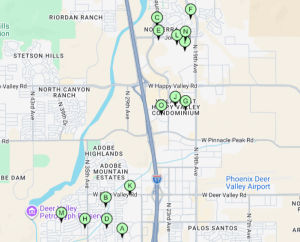
Phoenix 15 stops
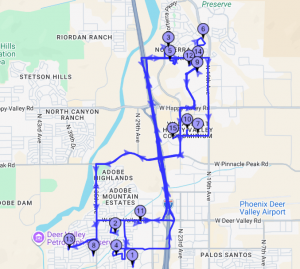
Phoenix Keep order as is
Optimized Route
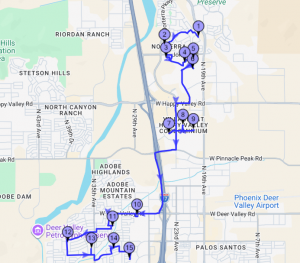
Phoenix optimized route
- Deer Valley homese
- Norterra homese
- Happy Valley homese
Instead of bouncing between neighborhoods, the technician moves through each area once.
Before vs After Route Results
Original route
- Stops: 15
- Miles driven: 54
- Drive time: 2 hours
- Frequent neighborhood backtracking
Optimized route
- Stops: 15
- Miles driven: 11
- Drive time: 45 minutes
- Stops grouped by neighborhood
Why Recurring Routes Benefit the Most from Optimization
Recurring field service businesses see especially strong benefits from route planning because the routes repeat.
If a route becomes 30 minutes more efficient, that improvement happens every week or every month.
For example:
A pest control route that saves 30 minutes per day might allow the company to add one additional service stop to that route. Over a year, that single improvement can translate into hundreds of additional service visits.
Route planning also helps maintain consistency. When customers are grouped by area and assigned to stable route days, technicians become familiar with the neighborhoods they serve and the schedule becomes easier to manage.
Other Recurring Service Routes
Recurring routing challenges appear across many industries. Here are three common examples.
Lawn Care Route Example
A lawn care crew servicing suburban Orlando may complete 13 properties in one day.
Without route planning, the crew might move between subdivisions multiple times because properties were added over time wherever availability existed.
When the route is reorganized by neighborhood clusters, the crew can complete each subdivision sequentially, reducing travel time and allowing more predictable daily completion times.
Pool Service Route Example
Pool technicians often service many homes in a single neighborhood. But as new customers are added, the route can gradually expand into surrounding areas.
For example, a technician might service 12 pools across three nearby communities.
Grouping those pools by neighborhood allows the technician to complete each area in one pass instead of returning later in the day.
Best Practices for Recurring Service Route Planning
Recurring field service businesses typically improve route efficiency by focusing on a few key principles.
- Group customers geographically
The most efficient routes keep nearby properties together. - Assign consistent service days
Recurring customers should be tied to route days that match their geographic location. - Minimize route outliers
A single isolated customer can add significant travel time to a route. - Review routes periodically
Routes should be reviewed every few months as new customers are added.
Recurring Field Service Businesses That Benefit from Route Planning
Multi stop route planning is particularly valuable for businesses that perform repeated service visits.
Each of these businesses depends on efficient daily routes to keep technicians productive and service schedules reliable.
Explore Recurring Service Route Examples
You can explore detailed route examples for specific recurring service industries:
- Pest Control Route Planning
- Lawn Care Route Planning
- Pool Service Route Planning
Each example shows how real businesses organize stops and improve route efficiency.
Key Takeaway
Recurring field service businesses benefit from route optimization more than almost any other industry because their routes repeat.
A small improvement in routing can save time every service cycle, allowing businesses to complete more stops, reduce technician driving time, and create more consistent service schedules.
That is why effective multi stop route planning becomes a core operational advantage for recurring service companies.