Mother's Day Delivery Playbook for Florists & Gift Couriers
April 27, 2026
Mother’s Day 2026 falls on Sunday, May 10, and for delivery teams in the flower and gift business, it’s not just another holiday, it’s the Super Bowl. The National Retail Federation projects roughly $34 billion in spending this year, with 84% of U.S. adults planning to celebrate. Florists alone will move an estimated 15 million stems in a single weekend, including 7 million roses and 2.5 million tulips.
If you deliver bouquets, gift baskets, plants, or curated boxes year-round, the next two weeks decide whether you’ll spend Sunday night counting profits or fielding angry calls. This guide is for the dispatchers, owner-operators, and route planners who keep the promise: “It’ll be there before brunch.”
Why Mother’s Day breaks delivery operations
Most florists and gift shops handle 50-150 orders on a typical Saturday. On Mother’s Day weekend, that number can spike 5-10x, and unlike Valentine’s Day (where deliveries skew toward workplaces and one address per recipient), Mother’s Day is overwhelmingly residential. That changes everything about your routing math:
- Residential addresses are spread out. No more efficient downtown clusters with three deliveries in the same office tower.
- Time windows are tighter. Brunch is 10-12. Lunch with mom is 12-2. Family dinner is 5-7. Miss the window and the gift loses its moment.
- Recipients aren’t always home. Mom is at her daughter’s house. Or church. Or already on her way to brunch.
- Last-minute orders explode. Millennials in particular are driving a massive surge in same-day orders, while Boomers tend to order 4-7 days out, meaning you’re juggling pre-planned routes and incoming chaos simultaneously.
- Driver fatigue is real. A 14-hour Saturday followed by a 12-hour Sunday is how mistakes happen.
The shops that come out ahead aren’t the ones with the most drivers. They’re the ones with the smartest routing.
The 7-day countdown: an operations checklist
T-minus 7 days (Monday before)
Audit your driver roster. Confirm hours, vehicles, fuel cards, and backup phones. Lock in any temporary drivers now, by Friday, every gig worker in your city is already booked.
T-minus 5 days (Wednesday)
Pull your pre-orders into a single spreadsheet. Standardize the address format (no “behind the gas station, white house” entries). Geocode early so you catch typos and missing apartment numbers while there’s still time to call the customer.
T-minus 3 days (Friday)
Build your Saturday route plan as if Saturday were the actual holiday. About 30% of customers prefer Saturday delivery to avoid the Sunday rush, and your most loyal repeat buyers are in that group. Treat Saturday like a dress rehearsal: same drivers, same vehicles, same dispatch flow.
T-minus 1 day (Saturday)
Run optimization for Sunday’s known orders by 6 PM. Leave deliberate slack, at least 20-25% of each driver’s capacity unfilled, to absorb the inevitable Sunday morning order surge.
Mother’s Day (Sunday)
Re-optimize twice: once at 7 AM with all overnight orders, and again at 10 AM if you take same-day cutoffs. Don’t let drivers leave the shop with stale routes.
Five routing decisions that separate winners from losers
- Cluster by neighborhood, not by order time. A driver who hops across town to hit a “10 AM delivery” and then drives back is bleeding 30 minutes per swap. Time windows should constrain the route, not dictate it stop by stop.
- Assign perishables to your fastest drivers. Cut flowers in a hot van for 6 hours arrive looking like garbage. Hand them to your A-team and let newer drivers handle plants, chocolates, and sturdier gifts.
- Pre-load in delivery order, not order-received order. This sounds obvious. It is routinely ignored. Walk the warehouse Saturday night and reorganize.
- Build “no-contact” protocols ahead of time. A surprising number of recipients won’t be home. Decide in advance: doorstep with photo, neighbor, leave-with-management, or return-to-shop. Train every driver on the same script.
- Use the optimizer for the hard stops, not the easy ones. Your 80% routine deliveries don’t need much help. The 20% with weird addresses, narrow time windows, or special instructions are where smart routing software pays for itself ten times over in a single afternoon.
Beyond Mother’s Day: turning a holiday spike into year-round revenue
Here’s the part most operators miss. The customer who orders flowers on May 10 has a birthday list, an anniversary, a graduation in June, a Mother-in-Law’s Day in October, a Sweetest Day, a Christmas. Mother’s Day is the cheapest customer acquisition opportunity of your year, if you treat the delivery itself as the marketing.
A few low-effort moves that compound:
- A handwritten note from the driver. “Hope your mom loves these, call us anytime, we deliver year-round.” Costs nothing. Memorable.
- A QR code on the receipt that drops them into your subscription or recurring-delivery flow.
- A follow-up text two weeks later, not asking for another order, just asking how mom liked them. The reorder rate on this is shockingly high.
- A “Dad’s Day” reminder in mid-May. Father’s Day is June 21, 2026. The hardest part of any reorder is reminding the customer you exist.
Your dispatch software should be capturing every delivery address, every recipient name, every preference. That database, not the bouquets, is your real asset.
What this looks like with smart route planning
Whether you run two vans or twenty, the operational reality is the same: you have stops, time windows, vehicle capacities, and drivers with different skill levels. A spreadsheet and Google Maps will get you through a normal Tuesday. They will not get you through Mother’s Day weekend.
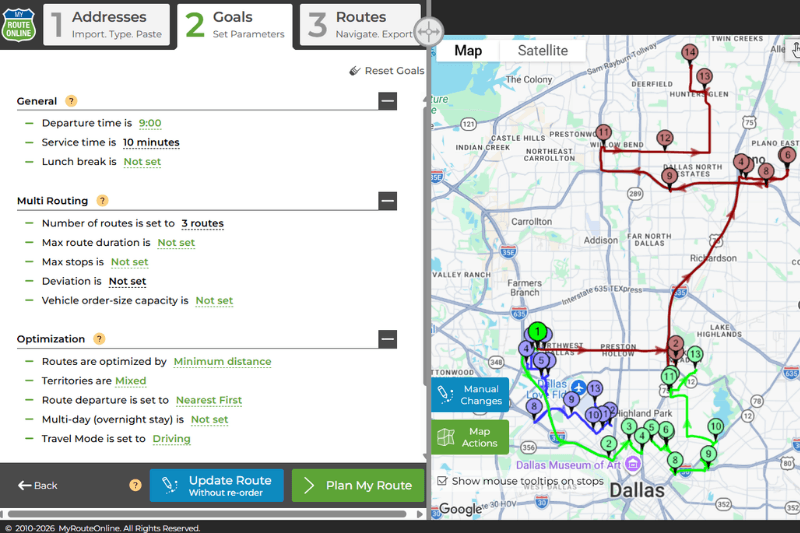
Modern route optimization tools, collapse the planning step from hours to minutes. Drop in your stops, set your constraints (time windows, driver availability, vehicle capacity), and the optimizer returns a sequence that minimizes drive time and maximizes on-time deliveries. The big unlock isn’t the optimization itself; it’s the ability to re-optimize on the fly when a same-day order lands at 9:47 AM and you need to slot it into someone’s route without unraveling the whole day.
For flower and gift businesses, that flexibility isn’t a nice-to-have on Mother’s Day. It’s the difference between a sold-out, profitable weekend and a pile of refunds.
The bottom line
Mother’s Day rewards preparation and punishes improvisation. The shops that win this Sunday are the ones that started planning two weeks ago, built buffer into every route, treated Saturday as a serious delivery day, and used their Sunday execution to turn first-time gift-givers into year-round customers.
Your drivers know moms. Your florists know flowers. Make sure your routes know the way.
FAQ about Mother’s Day Deliveries
When is Mother’s Day 2026?
Sunday, May 10, 2026. In the U.S. and most of North America, Mother’s Day always falls on the second Sunday of May.
What’s the best delivery window on Mother’s Day?
Aim for 9 AM to 12 PM whenever possible. Most recipients are still home before brunch plans kick in, and an early delivery means the flowers can be enjoyed all day. Late-afternoon windows (4–6 PM) are the second-best option for working families.
How many extra drivers should we hire for Mother’s Day weekend?
A common rule is to plan capacity for 4-6x your average Saturday volume across the Friday–Sunday window, with the heaviest staffing on Saturday. Lock in temporary drivers at least two weeks in advance, by the final week, supply dries up.
Should we accept same-day orders on Mother’s Day?
Only if you have the routing flexibility to absorb them without breaking existing time windows. A good rule: cap same-day orders at 20% of total Sunday capacity and set a hard cutoff (typically 11 AM or noon) so drivers can still finish on time.
What’s the biggest mistake delivery teams make on Mother’s Day?
Optimizing routes once and never re-running them. Orders shift, recipients call to change addresses, drivers run late. Re-optimize at least twice on Sunday, once first thing, and again mid-morning.
How do route optimization tools actually save time on a holiday like this?
A planner who spends 90 minutes manually sequencing 60 stops can get the same, usually better, result from optimization software in about 5 minutes. The real value is the ability to re-plan instantly when conditions change, instead of triaging by hand.
What about deliveries where the recipient isn’t home?
Decide your default protocol before Sunday morning. Most flower shops use one of: doorstep with photo confirmation, neighbor handoff with text notification, or return-to-shop with same-day re-delivery attempt. Pick one, train every driver on it, and communicate it to the customer at order time.
Is it worth using route optimization year-round, or just on holidays?
Year-round. The customer database, recurring-delivery patterns, and driver performance data you collect during normal weeks are exactly what makes Mother’s Day weekend smoother. Holidays expose whatever weaknesses already exist in your day-to-day operations.