Logistics Delivery Apps for Small Businesses
August 13, 2026
A logistics delivery app handles the core work of getting orders from a business to a customer: planning the route, dispatching drivers, confirming delivery, and keeping the customer informed along the way. Where these apps genuinely differ is in how they handle timing uncertainty. On-demand delivery apps are built around live tracking because neither the business nor the customer knows exactly when a driver will arrive. Scheduled-delivery apps are built around planning that route efficiently in the first place, since the stops are known ahead of time and the main job is doing that well.
Logistics Delivery Apps Compared
| App | Best for | Customer tracking | Pricing model |
| Onfleet | High-volume, on-demand dispatching and enterprise operations | Live map tracking, branded for customers | Plans from $619/month, with paid add-ons available on top |
| Detrack | Businesses that mainly want affordable tracking and proof of delivery | Embeddable live tracking widget | Per driver, from $29/month |
| Routific | Small to mid-sized businesses with fluctuating volume | Delivery notifications | Free for 100 orders/month, then from $150/month plus $0.15 per order over 1,000/month |
| Track-POD | Businesses prioritizing proof-of-delivery detail (partial deliveries, cash on delivery) | Branded live tracking page | $79/month, 3-driver minimum |
| MyRouteOnline | Small businesses running scheduled, multi-driver deliveries | Driver-sent arrival notifications, plus proof of delivery | Address-based, from $19/month for 50 orders up to $799/month for 15,000, no driver minimum |
MyRouteOnline as a Logistics Delivery App
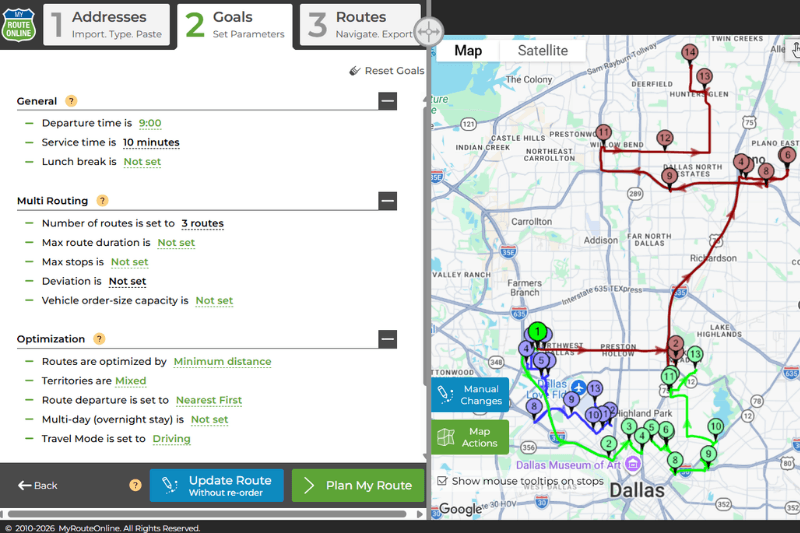
MyRouteOnline handles the same core job as any logistics delivery apps: importing a day’s orders, planning an optimized route across them, dispatching that route to multiple drivers, confirming each delivery with proof of delivery, and notifying customers as their driver approaches. What sets it apart from Onfleet, Detrack, and Track-POD isn’t a missing category, it’s a different point on the tracking spectrum. Instead of a live map link showing a customer their driver’s exact position in real time, MyRouteOnline drivers send arrival notifications directly, confirmation that a delivery is close, without the continuous GPS streaming a live map requires.
That tradeoff matters most for delivery timing, not for whether the app qualifies as a full logistics tool. A business that knows its stops in advance and can give customers a reasonable arrival window gets the same practical outcome, a customer who isn’t left wondering, without the added infrastructure and cost of live tracking.
Pricing: Where the Real Difference Shows Up
The sharpest difference between these apps isn’t features, it’s how each one prices growth. Track-POD charges $79 a month with a 3-driver minimum, so a 1 or 2-driver business pays for capacity it isn’t using. Detrack prices per driver from $29 a month, which stays affordable for a small team but climbs steadily as drivers are added. Routific’s paid tier adds a per-order fee once volume passes 1,000 a month, so the bill keeps climbing as the business grows. Onfleet’s entry plan starts at $619 a month, with paid add-ons on top, a price point built for volume well beyond most small operations.
MyRouteOnline’s tiers are flat and address-based instead, from $19 a month for 50 orders up to $799 a month for 15,000, with no driver minimum and no per-order add-on stacking on top as volume grows. For a small business handling scheduled, multi-driver deliveries, that pricing structure is built around the same job every logistics delivery app in this list is doing, just without the cost floor or the per-unit fee attached to a live-tracking feature the business may not need.
- On-demand delivery with no fixed time window: Onfleet’s live tracking is built for that uncertainty directly.
- Tracking and proof of delivery as the primary need, with routing secondary: Detrack’s per-driver pricing starting at $29/month is worth checking for that specific combination.
- Complex proof-of-delivery needs like partial deliveries or cash on delivery: Track-POD’s depth there is a real differentiator, worth the 3-driver minimum once a business already has that many drivers.
- Fluctuating volume with no clear monthly pattern: Routific’s usage-based pricing flexes with that, at the cost of a less predictable bill.
- Scheduled, multi-driver deliveries with a predictable monthly volume: this is what MyRouteOnline is built for, with pricing and setup that scale to match.
FAQ about Logistics Delivery Apps
What features should a logistics delivery app include for a small business?
At minimum, route planning to sequence stops efficiently, dispatch to assign and send routes to multiple drivers, proof of delivery to confirm each stop was completed, and a way to notify customers as their delivery approaches. Live map tracking is common in apps built for on-demand delivery, but it’s an added layer on top of those core functions, not a requirement for every delivery style. MyRouteOnline covers the core set, route planning, multi-driver dispatch, proof of delivery, and driver-sent arrival notifications, without the live-tracking layer.
Does MyRouteOnline offer proof of delivery?
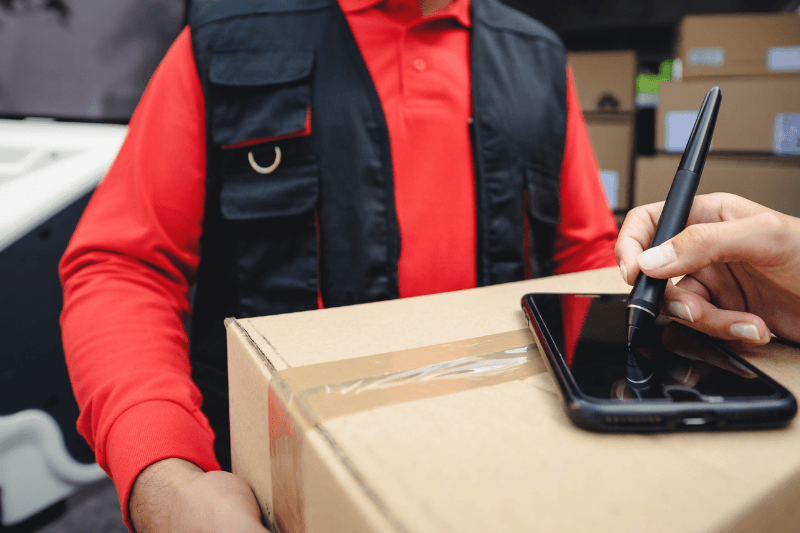
Yes. MyRouteOnline includes proof of delivery, and drivers can send customers arrival notifications directly, though it doesn’t include a live map link showing a customer the driver’s real-time position.
Is a driver minimum common in this category?
It varies by vendor. Track-POD, for example, requires a 3-driver minimum before any deliveries are made, meaning a smaller team pays for unused capacity. MyRouteOnline has no driver minimum, pricing is based on order volume instead of driver count.
Which logistics delivery app is best for a small business just getting started?
For a small business running scheduled, multi-driver deliveries, MyRouteOnline is built specifically for that case, with pricing that scales by order volume rather than driver count. A business doing on-demand delivery with unpredictable timing is usually better served by an app built around live tracking, like Onfleet.