What are the Best Tools for Creating Easy Routes for Delivery or Travel?
July 10, 2026
The right route planning tool depends entirely on what you are trying to do. A weekend road trip with four stops is a completely different problem from planning 80 deliveries across three drivers with time windows and proof of delivery requirements. This guide breaks down the best tools available in 2026 by use case, so you can choose the right one for your situation without wading through feature lists that do not apply to you.
What Makes a Route Planning Tool Easy to Use?
Ease of use in route planning comes down to three things: how quickly you can get your addresses in, how well the tool optimizes the order, and how easily your drivers can follow the result. A tool that requires a 30-minute setup before planning a route is not easy, regardless of how powerful it is. The best tools let you go from a list of addresses to an optimized, driver-ready route in a few minutes.
Best Free Tools for Simple Routes
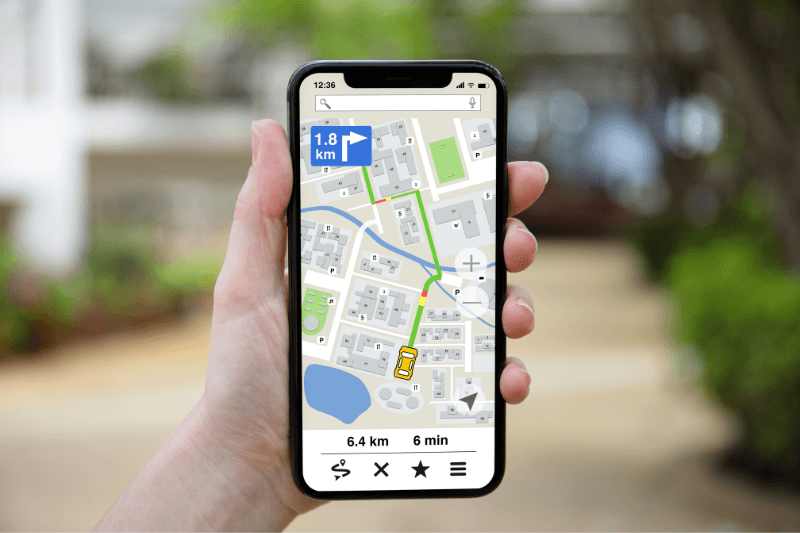
Google Maps is the most widely used free navigation tool in the world and works well for personal travel or very small delivery runs. You can add up to ten stops manually and get turn-by-turn directions on any smartphone. The limitations are significant for delivery work: it does not truly optimize complex stop order, it caps you at ten destinations, and it has no way to dispatch routes to multiple drivers or track progress in a structured way. For a quick personal trip or a handful of stops, it is hard to beat. For anything beyond that, it runs out of capability fast.
RouteXL is a browser-based tool that handles up to 20 addresses for free and optimizes the address order, which puts it a step ahead of Google Maps for small delivery runs. It does not have a native mobile app; routes sent to a phone open in a web browser rather than a dedicated app. This means drivers cannot access routes offline, which can be a limitation in areas with poor connectivity. RouteXL is a practical option for very small operations that need occasional route optimization without paying for a subscription, but it lacks tracking, proof of delivery, and dispatch tools that growing businesses need.
MapQuest offers free route planning with up to 26 stops and basic optimization. It works in a browser without an account and is a reasonable starting point for low-volume, occasional use. Like RouteXL, it lacks the dispatch tools and driver tracking that growing businesses need.
Best Tools for Small and Medium-Sized Delivery Businesses
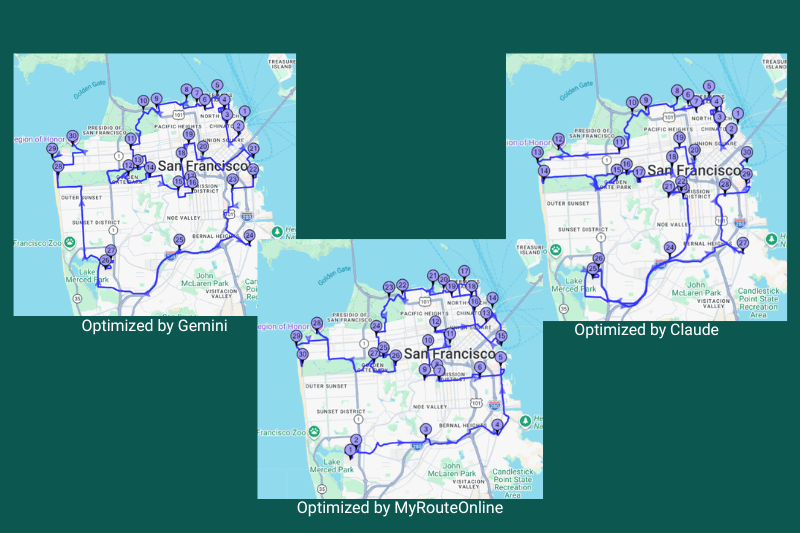
MyRouteOnline is built specifically for small and medium-sized businesses that need to plan multi-stop delivery routes, dispatch multiple drivers, and get everyone on the road efficiently. On higher-tier plans it supports up to 1,000 addresses per route, while mid-tier plans cover up to 350 addresses per route, so both small teams and larger fleets can work within one platform.
You can import addresses directly from Excel or CSV files and generate optimized routes in seconds. Drivers follow their routes using the MyRoute mobile app with turn-by-turn navigation, and dispatchers can track driver progress and route status from a single account.
New users can plan routes with up to 20 addresses for free upon registration, with no credit card required, which makes it easy to test the workflow before committing. Paid plans start at $19 per month, with tiers at $49, $99, $399, and $799 per month, each offering different monthly address credits and per-route limits up to 1,000 addresses. There are no per-driver fees, no per-address surcharges, and no long-term contracts. MyRouteOnline has been used by delivery businesses, field service companies, medical couriers, florists, and HVAC operators since 2009, giving small and medium-sized teams an affordable way to get enterprise-style route optimization without enterprise complexity.
Routific offers a permanently free tier for up to 100 orders per month, including unlimited drivers, tracking, proof of delivery, and route optimization, a genuine option for very small operations. Once you cross that threshold, pricing starts at about $150 per month for roughly 101 to 1,000 orders. That means 200 orders can cost the same as 1,000 orders on their entry paid plan. By comparison, MyRouteOnline’s Classic plan covers 500 addresses for $49 per month, and the next tier provides 1,200 monthly address credits for $99 per month. Businesses near the top of Routific’s free tier or just above it should compare both models against their actual monthly volume.
OptimoRoute offers per-driver pricing starting at $35.10 per driver per month and includes time windows, proof of delivery, and analytics. It is a solid option for businesses that prefer per-user pricing over flat monthly plans and want strong control over driver-level costs.
Best Tools for Travel Route Planning (Non-Delivery)
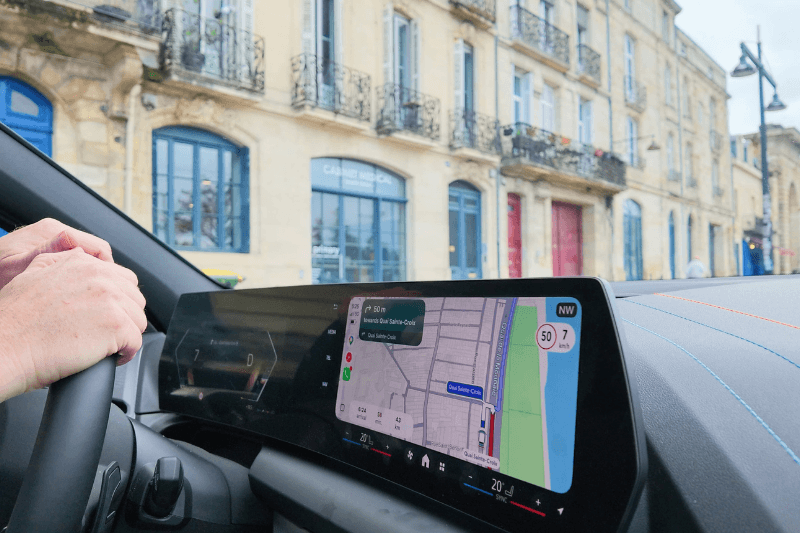
Google Maps remains the go-to for personal travel up to ten stops. It handles real-time traffic, has offline map support, and works on every platform. For a road trip with a handful of waypoints, nothing is simpler.
Roadtrippers is a travel-specific planning tool that adds points of interest, campsite suggestions, fuel stops, and lodging along a route. It is designed for leisure travel rather than delivery and works well for planning multi-day trips where discovery is part of the goal.
MyRouteOnline also works well for non-delivery travel planning that involves many addresses, such as sales visits, service calls, or multi-day inspection routes. If you have more than ten destinations and need to visit them in the most efficient order, it handles that regardless of whether the stops are deliveries or appointments.
Best Tools for Enterprise and Large Fleet Operations
Businesses managing large fleets, complex regulatory requirements, or integration with enterprise systems typically look at platforms like Descartes, Onfleet, or Route4Me. These tools offer deeper analytics, ERP integration, and fleet management capabilities beyond route optimization. They are more expensive, require implementation, and are designed for operations with dedicated logistics teams rather than owner-operators planning routes themselves.
How to Choose the Right Tool
The simplest way to choose is to match the tool to your address count and your team size. For personal travel or fewer than ten stops, Google Maps is free and sufficient. For 10 to 20 addresses with occasional use, RouteXL is a free starting point. For businesses processing between roughly 100 and 1,000 orders or addresses per month, compare flat-rate plans like MyRouteOnline’s against order-based pricing like Routific’s to see which model fits your actual volume. For businesses managing multiple drivers, time-sensitive deliveries, and proof of delivery requirements, a purpose-built platform like MyRouteOnline, Routific, or OptimoRoute is the right investment. For enterprise fleet operations with complex integrations, enterprise platforms are worth the cost.
The single most important test is whether you can go from your address list to a route your drivers can follow in under five minutes. If the tool requires more setup than that for a routine delivery day, it is working against you rather than for you.
FAQ about the Best Tools for Creating Routes
What is the best free tool for planning delivery routes?
Google Maps is the most accessible free option but limits you to ten stops and does not optimize the address order in a way that suits complex delivery runs. RouteXL handles up to 20 addresses for free and optimizes the sequence, making it a better choice for small delivery runs. Routific offers a permanently free tier for up to 100 orders per month including tracking and proof of delivery. MyRouteOnline lets new users plan routes with up to 20 addresses for free upon registration, with no credit card required.
What is the easiest route planning tool for small delivery businesses?
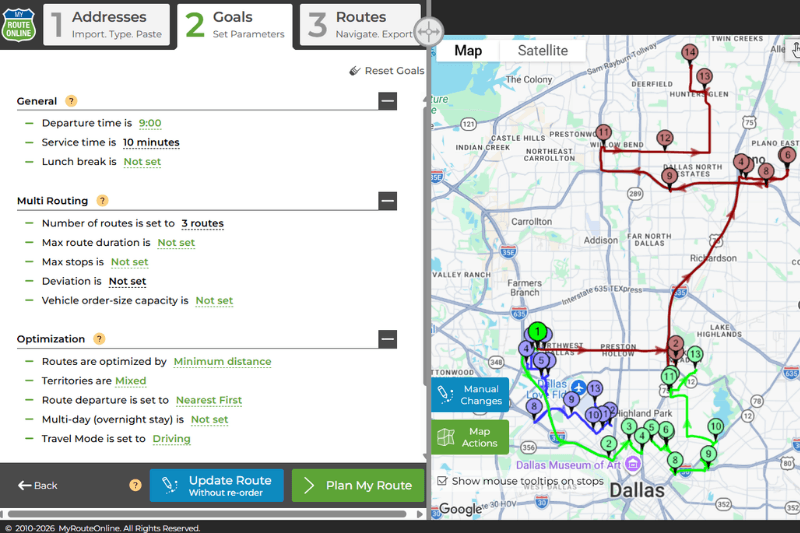
MyRouteOnline is designed for ease of use for small and medium-sized businesses. The workflow is three steps: import your address list from Excel, set your parameters, and plan your route. Most users are up and running within the first session. New users get 20 addresses free upon registration with no credit card required, and plans start at $19 per month.
Can I plan routes for multiple drivers at the same time?
Yes. MyRouteOnline lets you split a list of addresses across multiple drivers simultaneously, optimize each route independently, and dispatch them all from one account. Google Maps and most free tools do not support multi-driver dispatch in a structured way.
What is the difference between route planning and route optimization?
Route planning is the process of deciding which addresses to visit and in what general order. Route optimization is the process of calculating the most efficient sequence to minimize total drive time or distance across all addresses. Free tools like Google Maps do basic planning but not full optimization. Purpose-built tools like MyRouteOnline apply optimization algorithms to find the best possible sequence across dozens or hundreds of addresses, which is where meaningful time and fuel savings come from.
What is the best route planning tool for delivery businesses in 2026?
For small and medium-sized delivery businesses, MyRouteOnline offers the best combination of ease of use, address capacity up to 1,000 per route, flat pricing from $19 per month, Excel import, multi-driver dispatch, tracking, and mobile navigation. For very small operations processing under 100 orders per month, Routific’s free tier is worth considering. For larger operations with enterprise integration requirements, platforms like Descartes may be more appropriate depending on fleet size and budget.