Best Route Planning Apps and Tools, by What you're Actually Doing
September 10, 2026
“Best route planning app” depends entirely on the job. Getting through daily traffic, planning a road trip, dispatching a delivery team, and finding a hiking trail all need genuinely different tools, and the app that’s great for one is often the wrong choice for another. Here’s how the main categories break down, and which tool fits which job.
Everyday Driving and Navigation
Google Maps remains the default for daily driving, live traffic, and point-to-point navigation, strong ETA accuracy and a huge places database, but it caps out around 10 stops and doesn’t reorder them for you. Waze covers the same everyday-driving use case with a sharper focus on real-time, crowd-sourced traffic and hazard alerts, useful for commuting specifically, but like Google Maps, it isn’t built to plan or optimize a multi-stop route.
Road Trips and Vacation Planning
For scenic, multi-stop road trips, Roadtrippers is built around discovering things along the way, roadside attractions, campgrounds, and diners, not just the fastest route between two points. Wanderlog leans toward organizing a full vacation rather than just the driving, shared itineraries, flight and hotel tracking, and collaborative planning for a group trip.
Hiking, Cycling, and Outdoor Routes
AllTrails is the standard for trail discovery, with offline maps and a large community review base. Komoot covers similar ground for cycling and multi-day adventure travel specifically, with elevation and surface-type routing that AllTrails doesn’t focus on. Neither is built for planning delivery or business routes, they’re solving a different problem entirely.
Electric Vehicle Route Planning
EV driving adds a constraint none of the above handle well: charging. A Better Routeplanner (ABRP) is built specifically around that problem, calculating charging stops based on battery range, charger compatibility, and even weather and elevation, factors that meaningfully affect EV range in a way gas vehicles don’t need to account for.
Delivery Drivers and Business Route Optimization
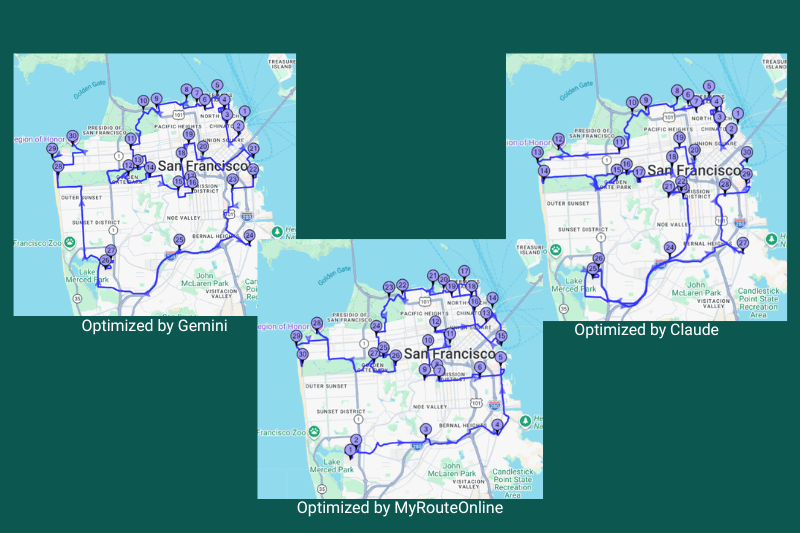
This is a genuinely different category from everything above: planning and optimizing routes with many stops, for a business, often across multiple drivers. A few tools compete here directly.
| Tool | Best for | Stop capacity | Pricing model |
| Circuit (Spoke) Route Planner | Independent delivery drivers working solo | Free tier capped at 10 stops; unlimited stops on the paid tier | Free up to 10 stops, $20/month flat for unlimited stops, solo-driver only, no multi-driver support at any tier |
| RoadWarrior Route Planner | Solo drivers and small teams with daily multi-stop routes | Up to 120 stops per route, 500 optimized stops per day on the Pro plan | $49/month, plus $20/month for each additional team member |
| Route4Me | Enterprise delivery operations needing deep customization | Scales with plan | Per-user pricing, with a marketplace of separately-priced add-ons |
| MyRouteOnline | Small to mid-sized delivery and field service businesses running multi-driver routes | Up to 1,000 addresses in a single run | Address-based, from $19/month, every feature included on every plan |
The real differences here go beyond stop count. Circuit is genuinely the simplest to start with, but the Route Planner product covered here is solo-only, permanently, there’s no multi-driver plan at any price on it. Spoke does offer a separate product built for teams, Spoke Dispatch, with its own pricing not covered in this comparison. RoadWarrior scales to small teams but adds a per-member fee on top of the base plan, and its 120-stop-per-route ceiling is a real limit for a business planning a full day across a fleet. Route4Me stopped publishing its prices and offers a marketplace of paid add-ons for features like notifications, avoidance zones, and voice navigation, useful for a business that wants to configure exactly what it needs, but a real cost consideration for a smaller team.
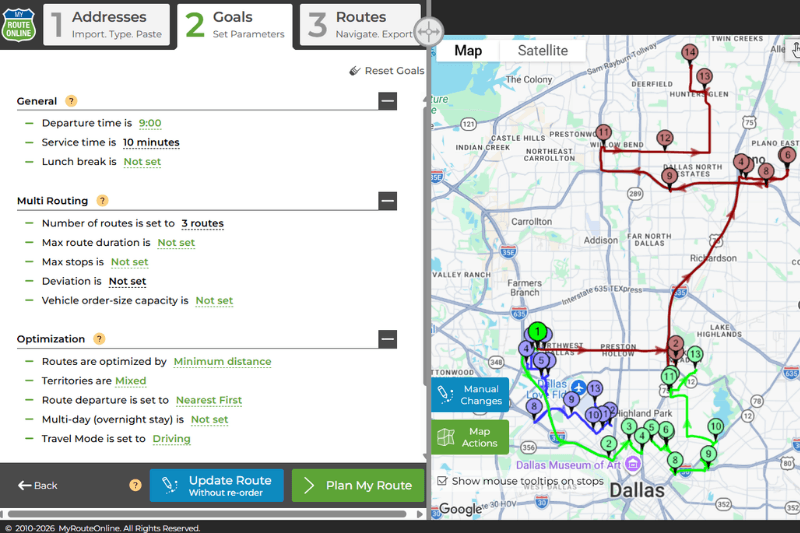
MyRouteOnline is built specifically for the middle of that range: a small or growing delivery, distribution, or field service business that needs to plan and dispatch routes across multiple drivers, without a per-driver fee stacking on top of the plan, and without an add-on marketplace to configure before the basics work. Every plan includes the full feature set, route optimization, the driver app, proof of delivery, and multi-driver dispatch, with pricing based on how many addresses are planned each month, not how many people are on the team.
Fleet and Enterprise Logistics
For large commercial fleets, platforms like Samsara and Verizon Connect operate a level up from the tools above, combining route optimization with vehicle telematics, driver monitoring, and fleet-wide analytics. These are built for enterprise fleet operations with dedicated logistics teams, a different scale and budget than a small delivery business planning routes for a handful of drivers.
Quick Recommendations
| Use case | Best pick |
| Daily driving | Google Maps |
| Traffic avoidance | Waze |
| Road trips | Roadtrippers |
| Vacation planning | Wanderlog |
| Solo delivery driving | Circuit (Spoke) |
| Multi-driver delivery and field service routing | MyRouteOnline |
| Hiking | AllTrails |
| Cycling and adventure travel | Komoot |
| EV travel | A Better Routeplanner |
| Enterprise fleet logistics | Samsara |
FAQ About Best Route Planner Tools and Apps
What’s the difference between a navigation app and a route optimization tool?
Navigation apps like Google Maps and Waze are built for point-to-point driving and real-time traffic, with a low cap on how many stops they can handle and no automatic reordering. Route optimization tools like MyRouteOnline calculate the most efficient order for many stops and dispatch that route to one or more drivers, a different job entirely.
What’s the best route planning app for a small delivery business with multiple drivers?
MyRouteOnline is built specifically for this case, address-based pricing with no per-driver fee, up to 1,000 addresses in a single run, and every feature, including multi-driver dispatch, included on every plan. Solo-driver tools like Circuit don’t support multiple drivers at any price, and per-driver tools like RoadWarrior and Route4Me add cost as a team grows.
How many stops can these delivery route planners actually handle?
Circuit’s free tier caps at 10 stops, but its paid tier ($20/month) allows unlimited stops, though it still only supports a single driver at any price. RoadWarrior’s Pro plan allows up to 120 stops per route and 500 optimized stops per day. MyRouteOnline supports up to 1,000 addresses in a single run.
Is Google Maps good enough for planning delivery routes?
For a small number of stops, yes. Past about 10 stops, Google Maps doesn’t reorder them for efficiency and isn’t built for dispatching multiple drivers, which is where dedicated tools like MyRouteOnline take over.