Back-to-School Route Planning: The Challenges Transportation Teams Face Every August
July 27, 2026
Every summer ends the same way for transportation departments that serve schools: a quiet few months followed by a compressed scramble to have routes ready before the first day back. New addresses, shifted boundaries, added stops, and a hard deadline that doesn’t move. Here’s what tends to go wrong during that window, and where a route planning tool like MyRouteOnline actually helps.
The Seasonal Crunch is Real
Enrollment changes late. Families move over the summer, new students register in the final weeks of August, and boundary or program changes get finalized later than anyone would like. That leaves transportation coordinators rebuilding routes under time pressure, often with a spreadsheet that was accurate in June and is missing a dozen addresses by the time routes need to be finalized.
Where the Time Actually Goes
Manually entering addresses one at a time. Slow and error-prone, especially under deadline pressure.
Guessing at stop order. Past a handful of stops, there are more ways to get the sequence wrong than right, and a poorly ordered route means wasted time and mileage every day of the school year.
Coordinating more than one driver or vehicle. Splitting a growing stop list fairly across drivers is hard to do by eye.
Rebuilding routes when something changes again. Whatever process was used to build the original routes needs to handle updates just as easily, not require starting over.
What MyRouteOnline Actually Solves Here
MyRouteOnline isn’t a full transportation management platform. It doesn’t have student-facing or parent-facing tracking, there’s no app for families to see where a bus is. What it does well is turning a list of addresses into an efficient route, quickly, and making that repeatable every time the list changes.
- Bulk import from Excel or CSV.
- Automatic stop-order optimization for up to 1,000 stops.
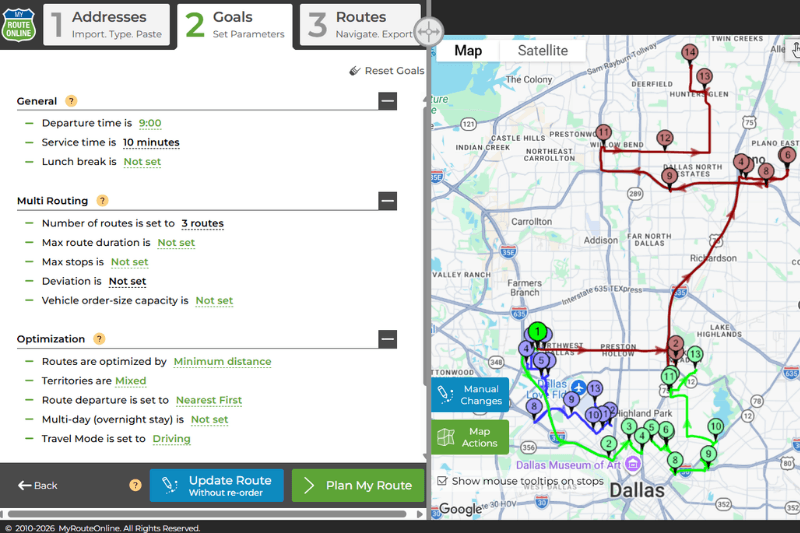
- Multi-route optimization and Multi-driver dispatch.
- Route tracking for the transportation office to see route progress.
- Fast to set up, easy to update, with no lengthy onboarding process.
Who this is Built for
This approach tends to work best for smaller districts, transportation consortiums, and auxiliary routes, field trips, special education vans, or other district vehicles, where a full GPS-and-tracking platform built around parent notifications is more infrastructure than the situation calls for.
Plans start at $19 per month for 50 orders and scale up to $799 per month for 15,000 orders, with no long-term contract required.
FAQ about Planning Bus Routes
How late in the summer can routes still be built efficiently?
Since stops can be imported directly from Excel or CSV and optimized automatically, routes can realistically be built or rebuilt within days of the first day of school, not weeks.
Can routes be updated after school starts?
Yes. New or changed addresses can be added and the route re-optimized at any point.
Does MyRouteOnline replace a full school transportation platform?
No. The office can track route progress from the admin dashboard, but there’s no parent-facing or student-facing app showing families where the bus is. Districts that need that kind of parent notification feature, or student information system integration, will need a dedicated K-12 platform for those pieces.
Is there a trial available before committing for the school year?
Yes, with no credit card required.