UPS, Amazon & FedEx Holiday Fees are Rising. Learn How Small Businesses Can Offset it
September 18, 2026
Every major carrier is raising prices for this holiday season, and the increases started before Halloween decorations even went up. If you ship, deliver, or dispatch drivers for a living, the math on this peak season already looks different than last year’s, and most of it is happening whether you plan for it or not.
What’s Actually Changing this Year
UPS’s holiday surcharges follow a three-tier calendar most businesses haven’t fully priced in yet. Packages needing additional handling cost $8.75 each from September 27 through November 21, then jump to $11.90 from November 22 through December 26, before dropping back to $8.75 through January 16. Large packages follow the same pattern, from $96.25 up to $117.50 during the peak window. Packages over the maximum size limit go from $530 to $590.
Amazon isn’t running one peak period this year, it’s running three: October 25 to November 21, November 22 to December 26, and December 27 to January 16, each with its own surcharge. FedEx and USPS are raising fees too, with increases beginning as early as September and stretching into January.
None of this is happening in isolation. AAA’s National Average put diesel at $6.40 a gallon on September 17, 2026, an all-time national record, up 42 cents in a single week and $2.69 from a year earlier. Freight industry reporting also points to van contract rates running 18% above last year and spot trucking rates up 35.6%. Carriers are passing rising fuel and capacity costs down the chain, and a lot of that lands directly on the businesses shipping through them.
The Part of this Bill You Don’t Actually Control
Carrier surcharges, fuel prices, and freight rates are all set by someone else. A small delivery business or field service company can’t negotiate UPS’s peak pricing calendar down, and it can’t make diesel cheaper. That’s the frustrating part of this story, and it’s also the reason it’s worth being precise about the one part of holiday shipping costs that actually is still yours to manage: how many miles your own drivers put in to get the job done.
At $6.40 a gallon, extra miles aren’t a rounding error, they’re real money, every single day of the season. A poorly sequenced route that runs 30 or 40 miles longer than it needs to isn’t just wasted time anymore, at that price, it’s a cost that compounds daily, right at the same time carrier surcharges are compounding on the shipping side. Two rising costs stacking on top of each other is a worse position than either one alone.
Why this Matters More During a Volume Spike, Not Less
Here’s where it gets counterintuitive. A lot of businesses tighten spending during a cost squeeze like this one, but route efficiency is exactly the wrong place to cut corners during peak season specifically, because peak season is when routing mistakes get multiplied. A business planning 50 stops a day in a normal month and 150 a day during the holiday crunch doesn’t just have three times the deliveries, it has three times the opportunity for a badly sequenced route to waste fuel at today’s record diesel price.
This is also the exact moment hiring pressure hits. Businesses add seasonal drivers to handle the volume spike, and on a lot of route planning tools, that means the software bill goes up right alongside the fuel bill, a per-driver fee stacking on top of a per-gallon cost increase. That’s a genuinely bad combination during a season where margins are already getting squeezed from the carrier side.
What Actually Helps Right Now
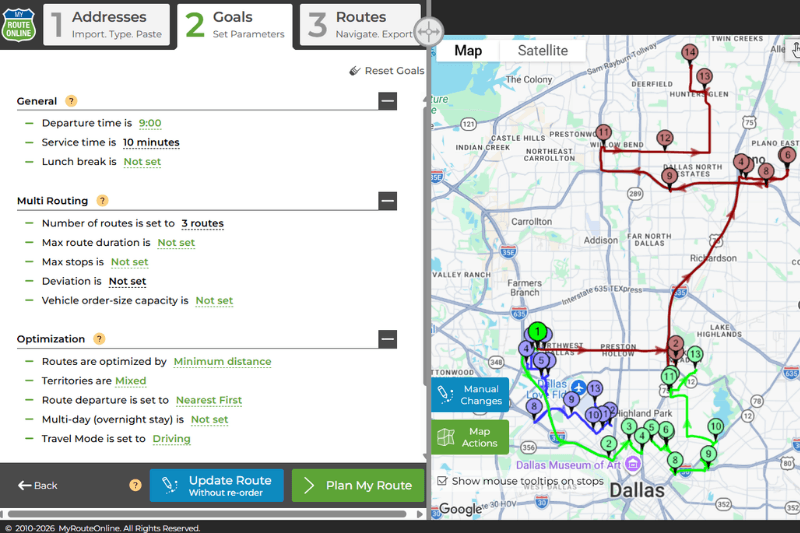
- Route optimization directly offsets the fuel-cost side of this squeeze. Every mile a well-sequenced route avoids is a mile that doesn’t get charged at $6.40 a gallon.
- Address-based pricing avoids stacking a second cost increase on top of the first. If seasonal hiring is part of the plan this year, a route planning tool that charges by order volume rather than by driver headcount means the software bill doesn’t rise in lockstep with the fuel bill.
- Bulk import matters more when volume triples overnight. Manually entering a holiday-season address list one line at a time is a bad use of time in a season where every hour is already stretched.
- Multi-driver dispatch from one account means a business scaling from 2 drivers to 6 for the season can plan and balance all of it in one place, not five separate manual sessions.
The Bottom Line
Carrier fees are going up this holiday season, that part is already decided. What’s still an open question is how much of that gets absorbed by your own operation versus offset by it. A business running efficient routes this season isn’t paying less to UPS or Amazon, but it is paying less for everything those carrier fees don’t cover, the fuel, the hours, and the miles that are still entirely within its own control.
FAQ About Shipping Costs
How much are UPS holiday surcharges going up this year?
UPS’s additional-handling surcharge rises from $8.75 to $11.90 per package between November 22 and December 26, before returning to $8.75 through January 16. Large package surcharges rise from $96.25 to $117.50 during the same peak window.
What’s the current price of diesel, and why does it matter for route planning?
AAA’s National Average put diesel at $6.40 a gallon on September 17, 2026, an all-time national record. At that price, extra unplanned miles from a poorly sequenced route cost meaningfully more than they would have in a lower-price year, making route efficiency a bigger factor in overall delivery costs than usual.
Does adding seasonal drivers increase route planning software costs?
It depends on the pricing model. Per-driver route planning tools charge more as a business adds seasonal drivers, stacking a software cost increase on top of rising fuel and carrier costs. Address-based pricing, which charges by order volume instead, doesn’t increase just because a team temporarily grows.
Is this holiday season’s carrier fee increase unusual?
FedEx, UPS, USPS, and Amazon are all raising peak-season fees for 2026, with increases starting as early as September and extending into January, following a broader industry pattern of rising fuel and capacity costs this year.